Florida Fire Lane Striping Requirements Explained

A delivery truck parked across a faded fire lane can create a serious problem long before an emergency occurs. For commercial property managers, fire lane striping requirements Florida properties must follow are not just a paint-maintenance issue. They affect emergency access, fire inspections, tenant operations, liability exposure, and the overall condition of the site.
The challenge is that a fire lane that looks acceptable on one property may not satisfy the authority having jurisdiction on another. Florida's fire code framework establishes broad safety expectations, but local fire marshals, fire departments, and municipalities often set or enforce the details for lane width, signage, curb color, wording, and placement. The right approach is to verify local requirements before restriping, then complete the work with materials and layout that remain visible under Central Florida traffic, sun, and rain.
Who Sets Fire Lane Striping Requirements in Florida?
The Florida Fire Prevention Code provides the statewide foundation for fire apparatus access roads and emergency access. In practice, the local authority having jurisdiction, commonly called the AHJ, has a major role in approving how those requirements are applied at a specific property.
For a shopping center, apartment community, medical office, warehouse, school, or industrial facility, the AHJ may be the local fire marshal's office, fire department, or municipal code enforcement department. Site plans approved during construction can also contain fire-lane details that still apply years later. That is why a contractor should not simply repaint the existing markings without first considering whether the original layout is current, legible, and consistent with local direction.
Requirements can differ between jurisdictions and property types. A lane serving a multi-story apartment building may be evaluated differently from an access route around a warehouse. Hydrant access, building height, turning radii, gates, loading activity, and the type of responding fire apparatus can all affect the required configuration.
What a Compliant Fire Lane Usually Includes
A properly marked fire lane must clearly communicate that the area is reserved for emergency access and cannot be used for parking, storage, loading, or staging. The exact method varies locally, but most Florida commercial properties use a combination of pavement markings, curb markings, and signs.
Clear, Unobstructed Emergency Access
Fire lanes need sufficient clear width for emergency vehicles. Many jurisdictions use a 20-foot minimum unobstructed width as a baseline, but property managers should not assume that measurement applies everywhere or resolves every issue. A local fire official may require additional width, a designated turning area, or a clear vertical height where tree canopies, building overhangs, gates, or utility features are involved.
The usable route matters as much as the striping. Dumpsters, pallets, contractor equipment, parked trailers, outdoor displays, and delivery vehicles can make a marked lane noncompliant even when the paint is new. Properties with frequent deliveries should establish a designated loading plan so normal operations do not conflict with emergency access.
Pavement Markings and Curb Paint
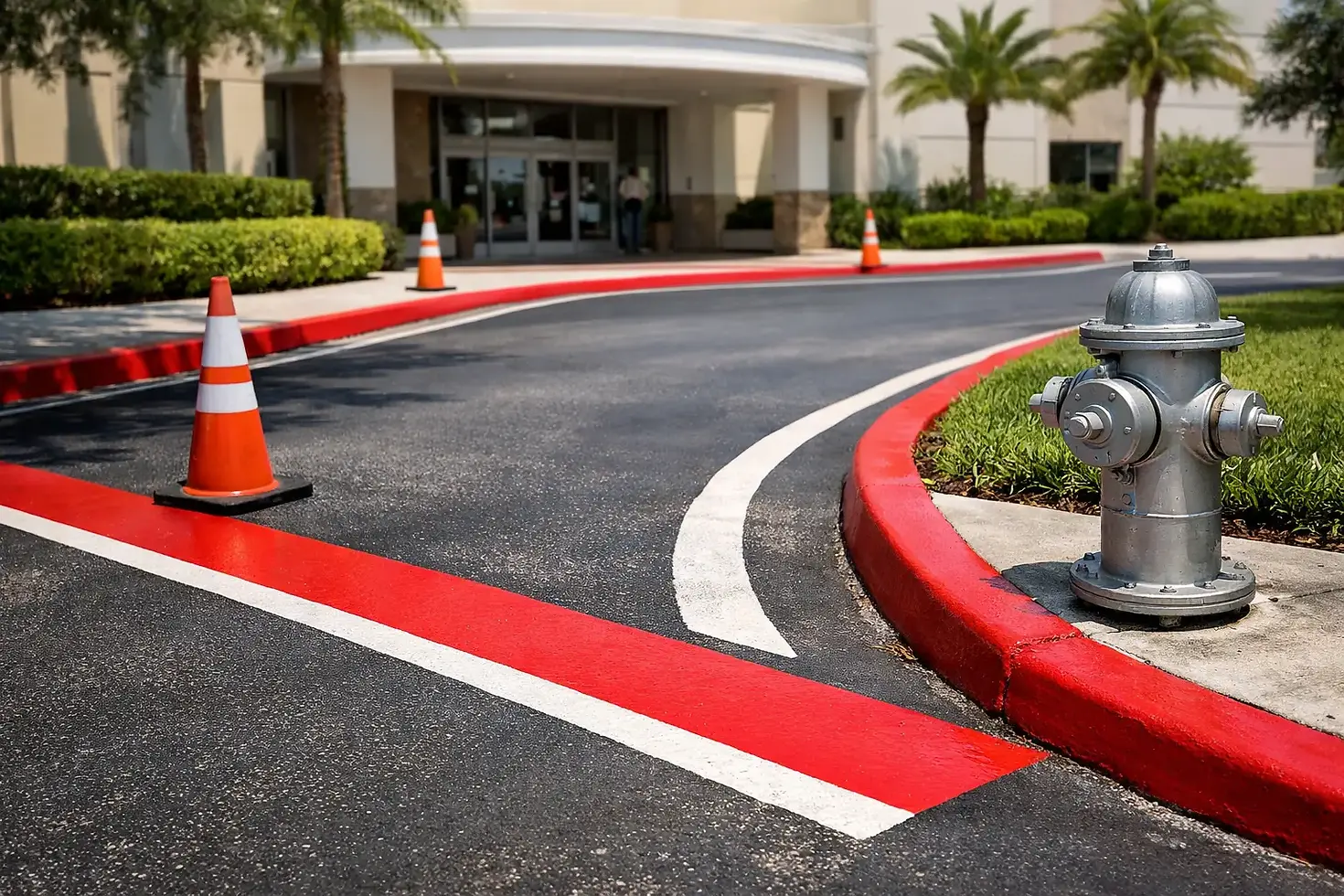
Fire-lane markings commonly include red-painted curbs, red striping, or both. Pavement lettering often states “FIRE LANE” and “NO PARKING,” although the required wording, letter size, color contrast, and interval between markings should be confirmed locally.
A curb may be physically intact but no longer serve its purpose if the red paint has faded to pink, chipped away, or been covered by runoff stains and tire scuffs. On wide access drives without curbs, pavement striping and repeated lettering become especially important because drivers need a visible boundary between travel lanes, parking spaces, and restricted emergency access.
Good preparation affects how long markings last. A professional striping scope should account for cleaning, surface condition, proper layout, compatible traffic paint, and masking or stenciling that produces clean lines and readable letters. Applying paint over loose debris, failed sealcoat, or deteriorated asphalt may look acceptable briefly, but it rarely delivers lasting value.
Required Fire Lane Signs
Signs are often required even when curbs and pavement lettering are present. Sign requirements may address the message, red-and-white color scheme, mounting height, spacing, direction of travel, and whether the sign identifies towing enforcement. The fire marshal or local code office is the best source for the approved format.
Signs deserve a field review before any restriping project. They can be blocked by landscaping, turned away from traffic, damaged by vehicles, or placed too far apart to be effective. Where a fire lane borders tenant storefronts or a busy pickup area, visible signs help prevent the recurring misuse that quickly ruins a freshly striped lane.
Fire Lanes Are Not Standard Parking Lot Markings
Fire lane work is often scheduled with parking lot restriping, but it should be treated as a separate compliance item. Standard parking stalls guide vehicles. Fire lanes protect emergency access. Combining both scopes is efficient when the lot is due for a refresh, but the layout should be reviewed before paint is ordered or crews arrive.
This distinction is particularly relevant when a property has been repurposed. A former retail building may now house medical offices. An industrial site may have added trailer parking. An apartment community may have changed visitor parking patterns. Those operational changes can put pressure on the fire lane and create informal parking habits that were not present when the site was originally approved.
ADA markings also serve a different purpose. Accessible parking spaces, access aisles, directional arrows, loading zones, and fire lanes must work together without creating conflicting striping. A site evaluation can identify faded markings, encroaching stalls, blocked access aisles, and other layout problems before they become an inspection issue.
When to Review Your Property's Fire Lane Markings
A fire lane should be reviewed at least as part of regular pavement maintenance, and sooner when there is evidence that the markings are no longer doing their job. Florida weather is hard on traffic paint. Sun exposure, heavy rain, power washing, vehicle traffic, and sealcoat wear can reduce visibility faster than many owners expect.
A practical review is especially worthwhile after a fire inspection notice, tenant turnover, parking lot resurfacing, sealcoating, curb replacement, site construction, or changes to loading and delivery operations. It is also wise to inspect before the busy season at retail, hospitality, and multifamily properties, when parking demand and visitor traffic increase.
Look for these conditions during a site walk:
Faded or missing red curb paint and pavement lettering
Fire lane signs that are damaged, blocked, missing, or poorly positioned
Vehicles routinely parking or loading in the marked lane
New landscaping, gates, dumpsters, or equipment reducing clear access
Striping that conflicts with parking stalls, ADA markings, or traffic flow
The purpose of the review is not simply to identify paint that needs refreshing. It is to confirm that the emergency route functions as intended.
Plan Striping Work Around Local Approval and Site Conditions
For an existing property, start by gathering available site plans, prior inspection reports, and any written direction from the local fire authority. If requirements are unclear, ask the AHJ for clarification before work begins. This is particularly valuable on properties with a history of inspections, complex circulation patterns, or multiple buildings.
Next, assess the pavement. Crack filling, asphalt patching, drainage corrections, or curb repair may need to happen before striping. Painting a fire lane over failing asphalt does not correct the underlying condition, and upcoming repairs can force the property to pay for the same markings twice.
Scheduling also matters. Retail centers may need work completed overnight or in phases. Medical facilities need maintained access for patients and emergency vehicles. Warehouses may require coordination around truck traffic and shift changes. A contractor experienced with commercial pavement maintenance can phase the work to limit disruption while maintaining safe access throughout the project.
Choose a Scope That Holds Up Over Time
The lowest striping quote is not always the lowest operating cost. A scope should clearly identify the surfaces to be marked, the wording and symbols to be applied, curb painting, sign considerations, traffic-control needs, preparation, and any repairs excluded from the striping work. Clear documentation helps property managers compare proposals on scope and workmanship rather than price alone.
For properties with several locations or recurring maintenance needs, fire lane markings can be included in a broader pavement-maintenance plan. Coordinating crack filling, repairs, sealcoating, and restriping at the right intervals helps protect the pavement and keeps critical markings visible without unnecessary repeat mobilizations.
Specialty Parking Lot Services LLC provides commercial fire lane striping, parking lot markings, curb painting, and pavement-maintenance services for Central Florida properties and qualifying larger projects throughout the state. A property evaluation can help identify whether the need is a straightforward repaint, a revised layout, or a larger repair-and-restriping scope.
Before your next inspection or paving project, walk the emergency access route as a fire truck would: Is it clear, visible, readable, and free from daily operational conflicts? If the answer is uncertain, request a free estimate and schedule a property evaluation before a faded line becomes a more costly issue.



Comments