
Industrial Parking Lot Paving for Heavy-Duty Sites

A warehouse driveway that carries loaded tractor-trailers cannot be built or repaired like a lightly used office parking area. Industrial parking lot paving must account for concentrated wheel loads, turning movements, delivery schedules, drainage, and the condition of the existing base. When those details are overlooked, new asphalt can rut, crack, or fail far sooner than a property owner expects.
For industrial facilities in Central Florida, pavement decisions also need to account for heavy rainfall, intense sun, and year-round traffic. The right solution is not always a complete replacement. In some cases, targeted base repair and resurfacing can provide excellent value. In others, paving over a failed foundation only delays a more expensive problem.
What Makes Industrial Parking Lot Paving Different?
Industrial pavement serves more than employee vehicles. It often supports delivery trucks, forklifts, trailers, roll-off containers, loading areas, and equipment that stops or turns in the same locations every day. Those repeated loads place far more stress on asphalt than normal passenger traffic.
The areas around loading docks, dumpster pads, truck entrances, trailer staging lanes, and tight turning radii are usually the first places to show distress. Surface cracking may be visible, but the more significant issue is often underneath: a weak, saturated, or shifting base that cannot support the load above it.
A sound paving plan starts by identifying how the site is actually used. A facility with occasional box-truck deliveries needs a different pavement section than a distribution center with frequent semi-truck traffic. Treating both properties the same can result in either unnecessary cost or a pavement system that is not built for the job.
Start With the Existing Pavement Condition
Before recommending asphalt repairs, milling and resurfacing, or full replacement, a contractor should evaluate the pavement beyond its overall appearance. Faded asphalt and minor surface wear do not automatically mean the lot needs to be torn out. However, widespread alligator cracking, depressions, potholes, and recurring failures are signs that a simple overlay may not be appropriate.
Alligator cracking is especially important. The interconnected pattern resembles reptile skin and typically indicates structural fatigue below the surface. Sealing those cracks or placing new asphalt over them without addressing the failed base may improve appearance temporarily, but traffic will usually bring the pattern back through the new surface.
A practical site evaluation should consider pavement thickness, base stability, drainage flow, truck traffic patterns, utility cuts, curb condition, and the locations of prior repairs. Cores or test areas may be helpful on larger projects when the pavement history is unknown. This information allows the paving scope to match the actual failure rather than just the visible symptom.
Design for Traffic, Not Just Square Footage
Square footage matters when developing a budget, but it does not determine the correct paving approach by itself. Industrial sites need pavement thickness and base preparation that reflect the loads carried in each section of the property.
Employee parking areas may have one set of needs, while truck lanes and loading approaches require a heavier-duty design. A property can often control costs by focusing the most substantial reconstruction work where trucks travel, turn, brake, and wait. There is little value in applying the same heavy section across every part of a site if those areas do not receive the same use.
The following locations should receive close attention during planning:
Main truck entrances and exit points where vehicles brake and accelerate
Loading dock approaches and trailer staging areas
Dumpster, compactor, and roll-off container pads
Intersections, tight turning areas, and fire lanes
Pavement next to drains, curbs, and low areas where water collects
This approach is not about cutting corners. It is about putting the right materials and preparation in the right places. A clearly defined scope also helps property managers compare proposals based on the work being performed, not simply the lowest number at the bottom of the page.
Base Repair Is Often the Deciding Factor
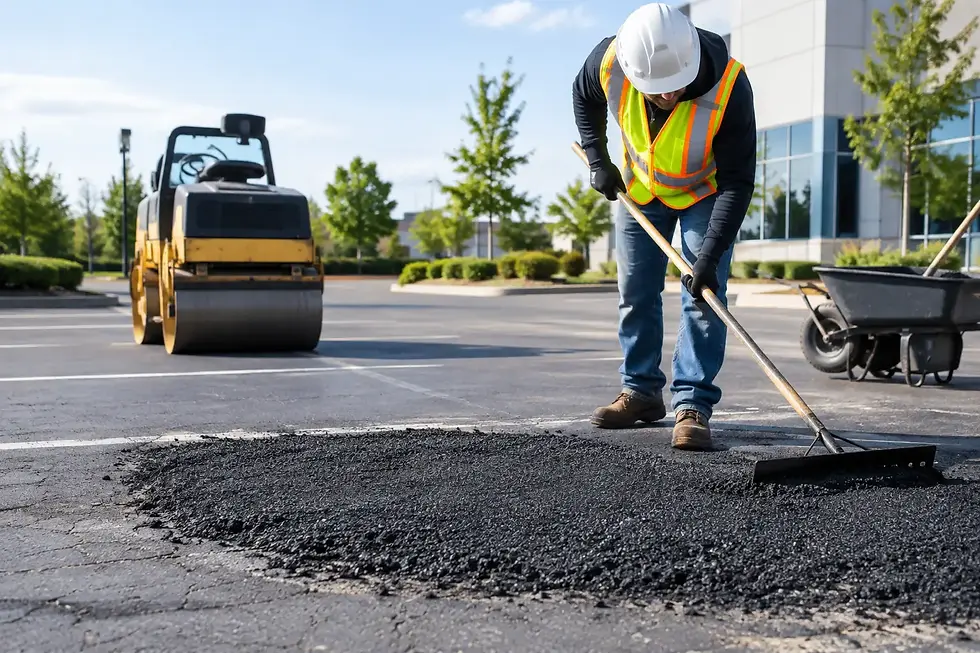
Asphalt depends on the base beneath it. If the aggregate base is soft, contaminated, or washed out, a new asphalt surface will not correct the underlying issue. In failed areas, full-depth repair typically involves removing damaged asphalt and unstable base material, rebuilding the foundation with properly compacted aggregate, and installing new asphalt to the intended grade.
The extent of base repair depends on the site. A few isolated failures may be repaired before resurfacing. If deterioration is widespread, a full reconstruction may be more cost-effective over the pavement's service life. A professional recommendation should explain why specific areas need deeper repair and why others may be suitable for a less extensive treatment.
Drainage Protects the Pavement Investment
Water is one of the most common causes of premature asphalt failure, particularly in Florida. When water remains on the surface, seeps through cracks, or enters the pavement edge, it can weaken the base and accelerate deterioration. Heavy rainfall can expose drainage problems that are not obvious during dry weather.
During industrial parking lot paving, finished grades must direct water toward intended drainage structures without creating low spots that pond after a storm. Milling and resurfacing work must also maintain proper transitions at curbs, drains, door thresholds, and concrete areas. Raising the pavement surface without considering those transitions can create drainage issues, trip hazards, or access problems.
Drainage repairs may involve adjusting grades, repairing failed areas near inlets, improving swales, or addressing damaged curbing. The appropriate remedy depends on the cause of the water problem. Simply adding asphalt to a low spot can sometimes redirect water toward a building or create an uneven surface nearby.
Plan the Work Around Facility Operations
Industrial paving projects do not happen in an empty lot. Many facilities need truck access, employee parking, emergency routes, and customer entrances available throughout the workweek. Good project planning protects the pavement work and helps the operation continue with less disruption.
Phased scheduling is often the best approach for active sites. A contractor can divide the property into manageable work zones, coordinate closures with facility staff, and sequence repairs around delivery windows. Clear communication before work begins is essential. Tenants, drivers, vendors, and employees need to know where to park, which entrances are open, and when freshly paved or sealed areas can be used.
Weather also matters. Florida rain can affect paving schedules, surface preparation, and the curing time for certain materials. A dependable contractor plans for conditions while communicating promptly when adjustments are necessary. Rushing asphalt installation on an unsuitable surface or during improper conditions is not a productive way to protect a commercial property.
Do Not Treat Paving as the Last Pavement Expense
New pavement needs a maintenance plan. Industrial traffic, sunlight, fuel drips, standing water, and the normal movement of the pavement will eventually create cracks and surface wear. Timely crack filling helps keep water out of the pavement structure, while sealcoating can protect suitable asphalt surfaces from oxidation and weathering.
Sealcoating is not a solution for structural failure, and it should not be used to disguise a pavement that needs repair. Once failed areas are corrected and the asphalt is in appropriate condition, however, regular maintenance can extend service life and improve the property's appearance. Fresh line striping and pavement markings also support traffic flow, pedestrian safety, fire-lane visibility, and ADA accessibility requirements.
Property managers with multiple locations often benefit from a documented maintenance schedule. Rather than responding only when potholes create an urgent issue, they can budget for inspections, crack repair, sealcoating, striping, and larger paving work based on actual pavement condition. That makes costs more predictable and reduces the risk of disruptive emergency repairs.
Choosing a Paving Partner for an Industrial Site
The right paving contractor should be able to explain the proposed scope in practical terms. Property decision-makers should understand which areas are being repaired, how deep the work will go, what materials are included, how drainage will be handled, and how the project will be scheduled around operations.
Price is part of every decision, but proposals should be evaluated for preparation, thickness, repair limits, compaction, traffic control, and warranty terms where applicable. A lower proposal may exclude base repair, drainage corrections, or proper transitions that are necessary for lasting performance. Comparing scope carefully is the best way to evaluate value.
Specialty Parking Lot Services LLC works with commercial and industrial property teams to assess pavement conditions, recommend practical repair or paving options, and coordinate work with site operations. For a Central Florida industrial property or qualifying larger Florida project, request a free estimate and schedule a property evaluation before minor pavement failures become operational problems.


Comments